Showing posts with label Stem Cells. Show all posts

5/10/2012

Transplanted gene-modified blood stem cells protect brain cancer patients from toxic side effects of chemotherapy


For the first time, scientists at Fred Hutchinson Cancer Research Center have transplanted brain cancer patients' own gene-modified blood stem cells in order to protect their bone marrow against the toxic side effects of chemotherapy. Initial results of the ongoing, small clinical trial of three patients with glioblastoma showed that two patients survived longer than predicted if they had not been given the transplants, and a third patient remains alive with no disease progression almost three years after treatment.


"We found that patients were able to tolerate the chemotherapy better and without negative side effects after transplantation of the gene-modified stem cells than patients in previous studies who received the same type of chemotherapy without a transplant of gene-modified stem cells," said Hans-Peter Kiem, M.D., senior and corresponding author of the study published in the May 9 issue of Science Translational Medicine.

Kiem, a member of the Clinical Research Division at the Hutchinson Center, said that a major barrier to effective use of chemotherapy to treat cancers like glioblastoma has been the toxicity of chemotherapy drugs to other organs, primarily bone marrow. This results in decreased blood cell counts, increased susceptibility to infections and other side effects. Discontinuing or delaying treatment or reducing the chemotherapy dose is generally required, but that often results in less effective treatment.

In the current study, Kiem and colleagues focused on patients with glioblastoma, an invariably fatal cancer. Many of these patients have a gene called MGMT (O6-methylguanine-DNA-methyltransferase) that is turned on because the promoter for this gene is unmethylated. MGMT is a DNA repair enzyme that counteracts the toxic effect of some chemotherapy agents like temozolomide. Patients with such an unmethylated promoter status have a particularly poor prognosis.

A drug called benzylguanine can block the MGMT gene and make tumor cells sensitive to chemotherapy again, but when given with chemotherapy, the toxic effects of this combination are too much for bone marrow cells, which results in marrow suppression.

By giving bone marrow stem cells P140K, which is a modified version of MGMT, those cells are protected from the toxic effects of benzylguanine and chemotherapy, while the tumor cells are still sensitive to chemotherapy. "P140K can repair the damage caused by chemotherapy and is impervious to the effects of benzylguanine," Kiem said.

"This therapy is analogous to firing at both tumor cells and bone marrow cells, but giving the bone marrow cells protective shields while the tumor cells are unshielded," said Jennifer Adair, Ph.D., who shares first authorship of the study with Brian Beard, Ph.D., both members of Kiem's lab.

The three patients in this study survived an average of 22 months after receiving transplants of their own circulating blood stem cells. One, an Alaskan man, remains alive 34 months after treatment. Median survival for patients with this type of high-risk glioblastoma without a transplant is just over a year.

"Glioblastoma remains one of the most devastating cancers with a median survival of only 12 to 15 months for patients with unmethylated MGMT," said Maciej Mrugala, M.D., the lead neuro oncologist for this study.

As many as 50 percent to 60 percent of glioblastoma patients harbor such chemotherapy-resistant tumors, which makes gene-modified stem cell transplant therapy applicable to a large number of these patients. In addition, there are also other brain tumors such as neuroblastoma or other solid tumors with MGMT-mediated chemo resistance that might benefit from this approach.

The researchers also found that chemotherapy increased the number of gene-modified blood and bone marrow cells in these patients. Kiem said this finding will have implications for other stem cell gene therapy applications where defective bone marrow stem cells can be corrected by gene therapy but their numbers need to be increased to produce a therapeutic benefit, or for patients with HIV/AIDS to increase the number of HIV-resistant stem and T cells.

The clinical trial is open and is recruiting more patients. For more information go to: http://clinicaltrials.gov/ct2/show/NCT00669669.

Source: Fred Hutchinson Cancer Research Center [May 09, 2012]

5/05/2012

Dynamic Changes in Gene Regulation in Human Stem Cells Revealed


A team led by scientists at The Scripps Research Institute and the University of California (UC) San Diego has discovered a new type of dynamic change in human stem cells. Last year, this team reported recurrent changes in the genomes of human pluripotent stem cells as they are expanded in culture. The current report, which appears in the May 4, 2012 issue of the journal Cell Stem Cell, shows that these cells can also change their epigenomes, the patterns of DNA modifications that regulate the activity of specific genes -- sometimes radically. These changes may influence the cells' abilities to serve as models of human disease and development.


"Our results show that human pluripotent stem cells change during expansion and differentiation in ways that are not easily detected, but that have important implications in using these cells for basic and clinical research," said team leader Louise Laurent, assistant professor in the UC San Diego School of Medicine.

Human pluripotent stem cells can give rise to virtually every type of cell in the body. Because of this remarkable quality, they hold huge potential for cell replacement therapies and drug development.

Many avenues of stem cell research focus on determining how genes are turned on and off during the course of normal development or at the onset of a disease transformation. It is widely accepted that gene activation and silencing play important roles in transforming all-purpose stem cells into the specific adult cell types that make up the specialized tissues of organs such as the heart and brain.

In the new study, Laurent and her collaborator, Professor Jeanne Loring of Scripps Research, and their colleagues focused on understanding gene silencing via DNA methylation, a process whereby bits of DNA are chemically marked with tags that prevent the genes from being expressed, effectively switching them off. Errors in gene silencing via DNA methylation are known contributors to serious developmental defects and cancer.

Specifically, the team assessed the state of both DNA methylation and gene expression in the most comprehensive set of human stem cell samples to date, composed of more than 200 human pluripotent stem cell samples from more than 100 cell lines, along with 80 adult cell samples representing 17 distinct tissue types. The researchers used a new global DNA methylation array, developed in collaboration with Illumina, Inc, which detects the methylation state of 450,000 sites in the human genome. The results showed surprising changes in patterns of DNA methylation in the stem cells. Because of the unprecedented breadth of the study, the researchers were able to determine the frequency of different types of changes.

One of the anomalies highlighted by the study centers on X chromosomes. Since female cells contain two X chromosomes and males only one, one of the X chromosomes in females is normally silenced by DNA methylation through a process called X-chromosome inactivation (XCI). The new study demonstrated that a majority of female human pluripotent stem cells cultured in the lab lost their X chromosome inactivation over time, resulting in cells with two active X chromosomes.

This phenomenon could affect stem cell-based models of diseases caused by mutations of the X chromosome, such as Lesch-Nyhan disease, the researchers note. These cell-based models require that only the diseased copy of an X-linked gene be expressed, with the normal copy of the gene in females silenced via XCI. As the originally inactive X chromosome becomes active, the normal copy of the gene is expressed, changing the phenotype of the cells from diseased to normal.

"If an X chromosome that was assumed to be inactive is actually active, scientists may find that their cells perplexingly change from mutant to normal over time in culture," Loring said.

Another epigenomic aberration noted in pluripotent cells was in imprinted genes. Human cells contain two copies of most genes: one inherited from the mother and one from the father. In most cases, both the maternal and paternal copies of a gene are expressed equally. This is not the case, however, for imprinted genes, some of which are only expressed from the paternal chromosomes and others expressed only from the maternal chromosomes. This parent-of-origin specific gene expression involves silencing of one of the copies of the gene. Abnormalities in this selective silencing of genes can lead to serious developmental diseases.

The study found that, while the patterns of DNA methylation required to maintain imprinted gene silencing were stable in all of the somatic tissues, surprisingly, frequent aberrations in the patterns of DNA methylation existed in imprinted genes in the stem cells. Some of these aberrations arose very early in the establishment of the cell lines, while others crept in with the passage of time.

Interestingly, the team was able to link at least some of these aberrations to the conditions under which the stem cells were cultured in the lab. This suggests that researchers who use stem cells to study diseases linked to genomic imprinting will need to use conditions that best maintain imprinted gene silencing.

The researchers found another surprise -- this one having to do with the basic process by which stem cells become specialized adult cells. Scientists have assumed that most genes are active at the earliest stages of human development, and that unnecessary ones are switched off as the cells developed specialized functions.

"For example, during the process of differentiation from a stem cell into a neuron, you might expect to observe silencing of all the genes that are important for the kidney, the pancreas, and the liver," said Kristopher Nazor, a Scripps Research Kellogg School of Science and Technology graduate student who is lead author of the study. "But we found something quite different."

When the team compared stem cells with adult cells taken from tissue samples, rather than seeing mostly active genes in the stem cells and selectively silenced genes in the adult ones, they saw the opposite: in the stem cells, the researchers found that genes linked to the development of specialized tissue cells were silent and methylated, while in the adult cells regions of DNA involved in cell type specification were active and unmethylated. The scientists could reproduce some aspects of the developmental changes in culture: when stem cells were differentiated into neural cells in the culture dish, the patterns of DNA methylation became similar to those seen in human brain tissue.

This implies that, contrary to conventional wisdom, the genes responsible for transforming stem cells into tissue cells were initially silent, and were switched on during the process of differentiation.

Source: The Scripps Research Institute [May 03, 2012]

5/04/2012

Stem Cells Poised to Self-Destruct for the Good of the Embryo


Embryonic stem cells -- those revered cells that give rise to every cell type in the body -- just got another badge of honor. If they suffer damage that makes them a threat to the developing embryo, they swiftly fall on their swords for the greater good, according to a study published online May 3, 2012 in the journal Molecular Cell.

This is an image depicting active Bax (red) located at Golgi of human embryonic stem cells. Nuclei are stained in blue [Credit: Deshmukh Lab, UNC-Chapel Hill]
The finding offers a new glimpse into the private lives of stem cells that could help scientists use them to grow new neurons or other cells to replace those that have been lost in patients with Parkinson's and other diseases. "Despite the huge potential of stem cells for therapeutic use, very few people have actually investigated their basic biology," said study senior researcher Mohanish Deshmukh, PhD, professor of cell and developmental biology at the University of North Carolina at Chapel Hill. "These results could have significant implications from a therapeutic perspective."

Of all the important things our bodies' cells do, staying alive is clearly key. But a cell's ability to die when something goes wrong is equally critical. For example, a faulty self-destruct button is one factor that allows cancer cells to proliferate unchecked and cause tumors.

Deshmukh and his colleagues discovered stem cells are extremely sensitive to DNA damage, which can be caused by factors like chemicals, radiation or viruses. The experiment showed that virtually 100 percent of human embryonic stem cells treated with a DNA-damaging drug killed themselves within 5 hours, as compared to 24 hours for other types of cells. "That's an incredibly rapid rate of death," said Deshmukh, who also is a member of the UNC Neuroscience Center and Lineberger Comprehensive Cancer Center.

The hair-trigger suicidal response is an important adaptation for embryonic stem cells, said the UNC School of Medicine researcher, because a slower response could allow DNA damage to proliferate and harm the embryo. "Mutations that develop in these cells could be catastrophic for the developing organism, so it would make sense for these cells to be rapidly eliminated."

The key to the stem cells' quick response is that they pre-activate a critical protein called Bax, the researchers found. In most cells, Bax is is kept in an inactive form, waiting for a long chain of events to rouse it into action if the cell becomes damaged enough to kill itself. In human embryonic stem cells, the team found Bax standing at attention in its active form in the Golgi apparatus, a part of the cell that processes and modifies proteins.

"What these cells do is very clever," said Deshmukh. "They have activated Bax, but they've also parked it in a safe little compartment -- the Golgi." If the cell detects DNA damage, Bax zips over to the mitochondrion (the cell's power plant), where it signals other proteins to shut the cell down.

It's like starting a 100-yard race at the 80-yard line, said Deshmukh. You're guaranteed to get to the finish line first because you did most of the work before the race began. However, there are built-in safeguards against a hair trigger activation of death. Pre-activated Bax is housed in the Golgi keeping the protein from accidentally triggering cell death when it's not warranted.

This extreme sensitivity to DNA damage lasts only a few days during early development. After the embryonic stem cells begin differentiating into early progenitors that give rise to specific cell types (like heart cells or skin cells), Bax reverts to its inactive state.

UNC Co-first authors of this study are -- Raluca Dumitru and Vivian Gama. Other UNC Co-authors include B. Matthew Fagan, Jacquelyn J Bower, Vijay Swahari and Larysa H Pevny. The study was funded by grants from the National Institutes of Health (National Institute of General Medical Sciences) and UNC's University Cancer Research Fund.

Source: University of North Carolina at Chapel Hill School of Medicine [May 03, 2012]

3/27/2012

Bone marrow stem cells can improve heart function


A research network led by a Mayo Clinic physician found that stem cells derived from heart failure patients' own bone marrow and injected into their hearts improved the function of the left ventricle, the heart's pumping chamber. Researchers also found that certain types of the stem cells were associated with the largest improvement and warrant further study. 


The results were presented March 26 at the 2012 American College of Cardiology Meeting in Chicago. They will also be published online in the Journal of the American Medical Association. 

This Phase II clinical trial, designed to test this strategy to improve cardiac function, is an extension of earlier efforts in Brazil in which a smaller number of patients received fewer stem cells. For this new network study, 92 patients received a placebo or 100 million stem cells derived from the bone marrow in their hips in a one-time injection. This was the first study in humans to deliver that many bone marrow stem cells. 

"We found that the bone marrow cells did not have a significant impact on the original end points that we chose, which involved reversibility of a lack of blood supply to the heart, the volume of the left ventricle of the heart at the end of a contraction, and maximal oxygen consumption derived through a treadmill test," says Robert Simari, M.D., a cardiologist at Mayo Clinic in Rochester, Minn. He is chairman of the Cardiovascular Cell Therapy Research Network (CCTRN), the network of five academic centers and associated satellite sites that conducted the study. The CCTRN is supported by the National Heart, Lung, and Blood Institute, which also funded the study. 

"But interestingly, we did find that the very simple measure of ejection fraction was improved in the group that received the cells compared to the placebo group by 2.7 percent," Dr. Simari says. Ejection fraction is the percentage of blood pumped out of the left ventricle during each contraction. 

Study principal investigators Emerson Perin, M.D., Ph.D., and James Willerson, M.D., of the Texas Heart Institute, explain that even though 2.7 percent does not seem like a large number, it is statistically significant and means an improvement in heart function for chronic heart failure patients who have no other options. 

"This was a pretty sick population," Dr. Perin says. "They had already had heart attacks, undergone bypass surgery, and had stents placed. However, they weren't at the level of needing a heart transplant yet. In some patients, particularly those who were younger or whose bone marrows were enriched in certain stem cell populations, had even greater improvements in their ejection fractions." 

The average age of study participants was 63. The researchers found that patients younger than 62 improved more. Their ejection fraction improved by 4.7 percent. The researchers looked at the makeup of these patients' stem cells from a supply stored at a biorepository established by the CCTRN. They found these patients had more CD34+ and CD133+ type of stem cells in their mixture. 

"This tells us that the approach we used to deliver the stems cells was safe," Dr. Simari says. "It also suggests new directions for the next series of clinical trials, including the type of patients, endpoints to study and types of cells to deliver." 

Source: Mayo Clinic [March 26, 2012]

3/13/2012

Scientists Produce Eye Structures from Human Blood-Derived Stem Cells


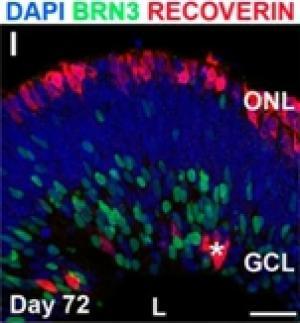
For the first time, scientists at the University of Wisconsin-Madison have made early retina structures containing proliferating neuroretinal progenitor cells using induced pluripotent stem (iPS) cells derived from human blood. 

At 72 days, stem cells derived from human blood formed an early retina structure, with specialized cells resembling photoreceptors (red) and ganglion cells (green) located within the outer and inner layers, respectively. Nuclei of cells within the middle layer are shown in blue. These layers are similar to those present during normal human eye development [Credit: University of Wisconsin-Madison]
And in another advance, the retina structures showed the capacity to form layers of cells – as the retina does in normal human development – and these cells possessed the machinery that could allow them to communicate information. (Light-sensitive photoreceptor cells in the retina along the back wall of the eye produce impulses that are ultimately transmitted through the optic nerve and then to the brain, allowing you to see.) Put together, these findings suggest that it is possible to assemble human retinal cells into more complex retinal tissues, all starting from a routine patient blood sample. 

Many applications of laboratory-built human retinal tissues can be envisioned, including using them to test drugs and study degenerative diseases of the retina such as retinitis pigmentosa, a prominent cause of blindness in children and young adults. One day, it may also be possible replace multiple layers of the retina in order to help patients with more widespread retinal damage. 

“We don’t know how far this technology will take us, but the fact that we are able to grow a rudimentary retina structure from a patient’s blood cells is encouraging, not only because it confirms our earlier work using human skin cells, but also because blood as a starting source is convenient to obtain,” says Dr. David Gamm, pediatric ophthalmologist and senior author of the study. “This is a solid step forward.” 

In 2011, the Gamm lab at the UW Waisman Center created structures from the most primitive stage of retinal development using embryonic stem cells and stem cells derived from human skin. While those structures generated the major types of retinal cells, including photoreceptors, they lacked the organization found in more mature retina. 

This time, the team, led by Gamm, Assistant Professor of Ophthalmology and Visual Sciences in the UW School of Medicine and Public Health, and postdoctoral researcher and lead author Dr. Joseph Phillips, used their method to grow retina-like tissue from iPS cells derived from human blood gathered via standard blood draw techniques. 

In their study, about 16 percent of the initial retinal structures developed distinct layers. The outermost layer primarily contained photoreceptors, whereas the middle and inner layers harbored intermediary retinal neurons and ganglion cells, respectively. This particular arrangement of cells is reminiscent of what is found in the back of the eye. Further, work by Dr. Phillips showed that these retinal cells were capable of making synapses, a prerequisite for them to communicate with one another. 

The iPS cells used in the study were generated through collaboration with Cellular Dynamics International (CDI) of Madison, Wis., who pioneered the technique to convert blood cells into iPS cells. CDI scientists extracted a type of blood cell called a T-lymphocyte from the donor sample, and reprogrammed the cells into iPS cells. CDI was founded by UW stem cell pioneer Dr. James Thomson. 

“We were fortunate that CDI shared an interest in our work. Combining our lab’s expertise with that of CDI was critical to the success of this study,” added Dr. Gamm.

Source: University of Wisconsin-Madison [March 13, 2012]

1/08/2012

Scientists identify lung cancer stem cells and new drug targets


Singapore scientists, headed by Dr. Bing Lim, Associate Director of Cancer Stem Cell Biology at the Genome Institute of Singapore (GIS), a research institute under the umbrella of the Agency for Science, Technology and Research (A*STAR), and Dr Elaine Lim, medical oncologist affiliated with Tan Tock Seng Hospital (TTSH) and National Cancer Centre Singapore (NCCS), have, for the first time, identified a gene responsible for lung cancer. The finding, reported in the advanced online issue of Cell on 5 January 2012, is a huge step towards finding a cure for the disease. 


A small number of cells, known as cancer stem cells or tumor-initiating cells (TIC), are responsible for the promotion of tumor growth. Dr. Bing Lim’s team was successful in finding a marker, known as CD166, to identify these cells. With the finding of this marker, the team then made more inroads into the genomic study of the TICs, and discovered several genes that were important for the growth of cancer cells. 

The metabolic enzyme known as glycine decarboxylase (GLDC) is a normal occurring enzyme in cells, present in small quantities. The scientists discovered that in abnormal instances when the level of GLDC rises significantly, it causes changes in the behavior of the cell, making it cancerous. 

"The manuscript from Dr. Bing Lim's laboratory provides a very exciting breakthrough about the unique metabolism of tumor initiating cells” said Dr. Lewis Cantley of Harvard Medical School. “This study builds on recent observations that a subset of cancer cells have enhanced serine/glycine metabolism. Importantly it shows that the enzyme glycine decarboxylase, which contributes to nucleotide synthesis, is elevated in lung tumor initiating cells and that it is critical for the ability of these cells to form tumors in vivo. Since glycine decarboxylase does not appear to be generally required for the growth of normal adult tissues, these results raise the possibility that this enzyme could be a target for cancer therapy." 

“This research is exemplary of the synergy between cancer researchers and clinicians that led to a breakthrough in our understanding of the metabolic pathway in lung cancer. I congratulate Dr. Bing Lim and Dr. Elaine Lim for leading this impressive multi-institutional study,” said Dr. Huck Hui Ng, Acting Executive Director of GIS. “The discovery of the biomarker has profound implications in cancer diagnostics and stratified medicine. It is hopeful that the metabolic enzyme GLDC will be a good target for drug development by the pharmaceutical industries."  

Dr. Bing Lim added “This is one of the most satisfying pieces of work I have orchestrated and the biggest credit must go to my post doctoral fellow, Dr. Wen Cai Zhang, who took the project from first establishing a xenograft model for human lung cancer to the identification of CD166 as a marker for lung cancer stem cell and culminating with the amazing discovery of the impact of a regular metabolic enzyme in carcinogenesis. It is doubly satisfying that we may have also identified a major drug target for controlling cancers”. 

Dr. John Wong, Vice Provost (Academic Medicine) of the National University of Singapore, explained that “Lung cancer is one of the most common causes of cancer death in Singapore and the region. There is an urgent need to better understand what drives this disease, especially as lung cancer in Asians appears to have major biological differences compared to that commonly seen in the West. The authors of this seminal paper should be congratulated as they represent the best of Team Science in Singapore, comprising both basic scientists and clinician investigators, all working to develop better therapies for Singaporeans and the community we live in. The findings from Dr. Bing Lim’s team strongly support the cancer stem cell paradigm and similar studies in other cancers need to be done.” 

Elaine Lim, co-corresponding author and co-principal investigator in this project said, “This paper is the result of successful co-operation between scientists and doctors from the Singapore Lung Cancer Consortium, with the Stem Cell division in GIS. The thoracic surgeons from TTSH, NCCS and NUHS have made outstanding contributions to this homegrown scientific project” 

Prof Soo Khee Chee, Director of NCCS, said that “NCCS has made important contributions to medical research through the years, both in clinical as well as basic research. This paper is an example of a very satisfying outcome when medical doctors and scientists huddle together to produce high-quality work. Co-operation between seemingly disparate disciplines amongst the different institutions in Singapore, led by Elaine and Bing, was critical to this success – and there will be many more to come” 

“This study has made significant contributions to our fundamental understanding of lung cancer,” added Prof Philip Choo, Chief Executive Officer at TTSH. “The study also represents an exceptional step forward for medical research involving doctors and scientists. We look forward to more of such collaborative efforts in the future.” 

More information: The research findings described in the press release can be found in the 5 January 2011 advanced online issue of Cell under the title “Glycine Decarboxylase Activity Drives Non-Small Cell Lung Cancer Tumor- Initiating Cells and Tumorigenesis”. 

Source: Agency for Science Technology and Research (A*STAR) [January 06, 2012]

1/07/2012

Flexible adult stem cells, right there in your eye


In the future, patients in need of perfectly matched neural stem cells may not need to look any further than their own eyes. Researchers reporting in the January issue of Cell Stem Cell, a Cell Press publication, have identified adult stem cells of the central nervous system in a single layer of cells at the back of the eye. 


That cell layer, known as the retinal pigment epithelium (RPE), underlies and supports photoreceptors in the light-sensitive retina. Without it, photoreceptors and vision are lost. The new study shows that the RPE also harbors self-renewing stem cells that can wake up to produce actively growing cultures when placed under the right conditions. They can also be coaxed into forming other cell types. 

"You can get these cells from a 99-year-old," said Sally Temple of the Neural Stem Cell Institute in Rensselaer, New York. "These cells are laid down in the embryo and can remain dormant for 100 years. Yet you can pull them out and put them in culture and they begin dividing. It is kind of mind boggling." 

Temple's group got the RPE-derived stem cells they describe from the eyes of donors in the hours immediately after their deaths. But the cells can also be isolated from the fluid that surrounds the retina at the back of the eye, which means they are accessible in living people as well. 

"You can literally go in and poke a needle in the eye and get these cells from the subretinal space," she says. "It sounds awful, but retinal surgeons do it every day." By comparison, access to most other neural stem cell populations would require major surgery. 

Temple said they were curious about the proliferative potential of the RPE given that the tissue is known to be capable of regenerating entire retinas in salamanders. But that plasticity in adulthood had seemed to be lost in mice and chicks. Still, "given the evolutionary evidence, we thought it was worth revisiting," she said. 

They placed RPE tissue taken from 22-year-old to 99-year-old cadavers into many culture conditions to see what they could make the cells do. They found one set of conditions that got the cells dividing. Not all of the RPE cells have this regenerative potential, but perhaps 10 percent of them do. 

Further work showed that the cells are multipotent, which means that they can form different cell types, though the researchers admit there is more to do to fully explore the cells' differentiation capacity. 

There are other implications as well. For example, these cells may explain diseases in which other tissue types show up in the eye. Their presence also suggests that there might be some way to stimulate controlled repair of the eye in the millions of people who suffer from age-related macular degeneration. 

"I think it might be possible," Temple said. 

Source: Cell Press [January 05, 2012]

World’s First Primate Chimeric Offspring Produced


Newly published research by scientists at Oregon Health & Science University provides significant new information about how early embryonic stem cells develop and take part in formation of the primate species. The research, which took place at OHSU's Oregon National Primate Research Center, has also resulted in the first successful birth of chimeric monkeys -- monkeys developed from stem cells taken from two separate embryos. 

Top: Roku and Hex. Bottom: Chimero [Credit: Images courtesy of Oregon Health & Science University]
The research is being published this week in the online edition of the journal Cell and will be published in a future printed copy of the journal. 

The research was conducted to gain a better understanding of the differences between natural stem cells residing in early embryos and their cultured counterparts called embryonic stem cells. This study also determined that stem cell functions and abilities are different between primates and rodents. 

Here's more information about the early primate stem cells that were studied: The first cell type was totipotent cells -- cells from the early embryo that have the ability to divide and produce all of the differentiated cells in the placenta and the body of organism. These were compared with pluripotent cells -- cells derived from the later stage embryo that have only the ability to become the body but not placenta. 

In mice, either totipotent or pluripotent cells from two different animals can be combined to transform into an embryo that later becomes a chimeric animal. However, the current research demonstrated that for reasons yet unknown, chimeric animals can only develop from totipotent cells in a higher animal model: the rhesus macaque. OHSU showed this to be the case by successfully producing the world's first primate chimeric offspring, three baby rhesus macaques named Roku, Hex and Chimero. 

"This is an important development -- not because anyone would develop human chimeras -- but because it points out a key distinction between species and between different kind of stem cells that will impact our understanding of stem cells and their future potential in regenerative medicine," explained Shoukhrat Mitalipov, Ph.D., an associate scientist in the Division of Reproductive and Developmental Sciences at ONPRC. 

"Stem cell therapies hold great promise for replacing damaged nerve cells in those who have been paralyzed due to a spinal cord injury or for example, in replacing dopamine-producing cells in Parkinson's patients who lose these brain cells resulting in disease. As we move stem cell therapies from the lab to clinics and from the mouse to humans, we need to understand what these cells do and what they can't do and also how cell function can differ in species." 

The OHSU Oregon National Primate Research Center and the National Institutes of Health funded the research. 

Source: Oregon Health & Science University [January 05, 2012]

Scientists Find Structure of Gene-Editing Protein


In the two and a half years since Adam Bogdanove, professor at Iowa State University in the Department of Plant Pathology and Microbiology, along with Matthew Moscou, a former graduate student in that department, discovered how a class of proteins from plant pathogenic bacteria find and bind specific sequences in plant genomes, researchers worldwide have moved fast to use this discovery. 

TALENs, represented by the colorful strands, bind to the double helix of a DNA [Credit: Image courtesy of Iowa State University]
Last year it was first shown that the proteins can be fused to DNA modifying enzymes to manipulate genes and gene functions by Bogdanove and colleagues at the University of Minnesota, led by former ISU professor Dan Voytas, and another group led by Iowa State University faculty member Bing Yang, professor in the Department of Genetics, Development and Cell Biology. 

The fused proteins are called TAL effector nucleases, or TALENs, and can be used to better understand gene function in model plant and animal systems, to improve traits in livestock and plants, and even to treat human genetic disorders, according to Bogdanove. 

The fact that these proteins can be readily engineered to bind DNA sequences of choice has resulted in a flurry of publications that demonstrate their utility in many different types of cells, including human stem cells. 

Largely because of the advent of TALENs, the journal Nature Methods last month named gene editing with engineered nucleases as 2011 Method of the Year. 

Now, Bogdanove and researchers from the Fred Hutchinson Cancer Research Center in Seattle have taken the next step by determining the 3-D structure of a TAL effector bound to DNA. 

The findings were posted this week on Science Express, a website for early release of papers of exceptional interest that are due to be published in an upcoming issue of the journal Science. 

The first author of the study is Amanda Mak, a postdoctoral researcher in the Hutchinson center. Andres Cernadas, a post doctoral researcher in Bogdanove's lab also contributed. 

By visualizing the shape of TAL effectors and how they physically interact with the DNA double helix, scientists can now better understand the biochemistry that underlies their ability to recognize and stick to specific DNA sequences. 

This will in turn improve scientists' ability to target the proteins to different locations in a genome and to better predict and prevent their binding to unintended, off-target sites, according to Bogdanove. 

The structure itself is also interesting from a basic biology standpoint. "It is really quite beautiful," he says, "So far there is nothing else in nature quite like it." 

To determine the structure, Bogdanove collaborated with Fred Hutchinson scientists Barry Stoddard, an expert in protein DNA interactions, and Phil Bradley, a computational biologist. Led by Stoddard, the group completed the project in just over a year by using a unique combination of traditional X-ray crystallography and novel computer-based modeling method. 

Source: Iowa State University [January 05, 2012]

1/06/2012

How work tells muscles to grow


We take it for granted, but the fact that our muscles grow when we work them makes them rather unique. Now, researchers have identified a key ingredient needed for that bulking up to take place. A factor produced in working muscle fibers apparently tells surrounding muscle stem cell "higher ups" that it's time to multiply and join in, according to a study in the January Cell Metabolism, a Cell Press journal. 


In other words, that so-called serum response factor (Srf) translates the mechanical signal of work into a chemical one. 

"This signal from the muscle fiber controls stem cell behavior and participation in muscle growth," says Athanassia Sotiropoulos of Inserm in France. "It is unexpected and quite interesting." It might also lead to new ways to combat muscle atrophy. 

Sotiropoulos' team became interested in Srf's role in muscle in part because their earlier studies in mice and humans showed that Srf concentrations decline with age. That led them to think Srf might be a culprit in the muscle atrophy so common in aging. 

The new findings support that view, but Srf doesn't work in the way the researchers had anticipated. Srf was known to control many other genes within muscle fibers. That Srf also influences the activities of the satellite stem cells came as a surprise. 

Mice with muscle fibers lacking Srf are no longer able to grow when they are experimentally overloaded, the new research shows. That's because satellite cells don't get the message to proliferate and fuse with those pre-existing myofibers. 

Srf works through a network of genes, including one known as Cox2. That raises the intriguing possibility that commonly used Cox2 inhibitors—think ibuprofen—might work against muscle growth or recovery, Sotiropoulos notes. 

Treatments designed to tweak this network of factors might be used to wake muscle stem cells up and enhance muscle growth in circumstances such as aging or following long periods of bed rest, she says. Most likely, such therapies would be more successfully directed not at Srf itself, which has varied roles, but at its targets. 

"It may be difficult to find a beneficial amount of Srf," she says. "Its targets, interleukins and prostaglandins, may be easier to manipulate." 

Source: Cell Press [January 03, 2012]

1/04/2012

Shot of Young Stem Cells Makes Rapidly Aging Mice Live Much Longer and Healthier


Mice bred to age too quickly seemed to have sipped from the fountain of youth after scientists at the University of Pittsburgh School of Medicine injected them with stem cell-like progenitor cells derived from the muscle of young, healthy animals. Instead of becoming infirm and dying early as untreated mice did, animals that got the stem/progenitor cells improved their health and lived two to three times longer than expected, according to findings published in the Jan. 3 edition of Nature Communications. 

Researchers have found that mice bred to age too quickly seemed to have sipped from the fountain of youth after being injected with stem cell-like progenitor cells derived from the muscle of young, healthy animals [Credit: © Vasiliy Koval/Fotolia]
Previous research has revealed stem cell dysfunction, such as poor replication and differentiation, in a variety of tissues in old age, but it's not been clear whether that loss of function contributed to the aging process or was a result of it, explained senior investigators Johnny Huard, Ph.D., and Laura Niedernhofer, M.D., Ph.D. Dr. Huard is professor in the Departments of Orthopaedic Surgery and of Microbiology and Molecular Genetics, Pitt School of Medicine, and director of the Stem Cell Research Center at Pitt and Children's Hospital of PIttsburgh of UPMC. Dr. Niedernhofer is associate professor in Pitt's Department of Microbiology and Molecular Genetics and the University of Pittsburgh Cancer Institute (UPCI). 

"Our experiments showed that mice that have progeria, a disorder of premature aging, were healthier and lived longer after an injection of stem cells from young, healthy animals," Dr. Niedernhofer said. "That tells us that stem cell dysfunction is a cause of the changes we see with aging." 

Their team examined a stem/progenitor cell population derived from the muscle of progeria mice and found that compared to those from normal rodents, the cells were fewer in number, did not replicate as often, didn't differentiate as readily into specialized cells and were impaired in their ability to regenerate damaged muscle. The same defects were discovered in the stem/progenitor cells isolated from very old mice. 

"We wanted to see if we could rescue these rapidly aging animals, so we injected stem/progenitor cells from young, healthy mice into the abdomens of 17-day-old progeria mice," Dr. Huard said. "Typically the progeria mice die at around 21 to 28 days of age, but the treated animals lived far longer -- some even lived beyond 66 days. They also were in better general health." 

As the progeria mice age, they lose muscle mass in their hind limbs, hunch over, tremble, and move slowly and awkwardly. Affected mice that got a shot of stem cells just before showing the first signs of aging were more like normal mice, and they grew almost as large. Closer examination showed new blood vessel growth in the brain and muscle, even though the stem/progenitor cells weren't detected in those tissues. 

In fact, the cells didn't migrate to any particular tissue after injection into the abdomen. 

"This leads us to think that healthy cells secrete factors to create an environment that help correct the dysfunction present in the native stem cell population and aged tissue," Dr. Niedernhofer said. "In a culture dish experiment, we put young stem cells close to, but not touching, progeria stem cells, and the unhealthy cells functionally improved." 

Animals that age normally were not treated with stem/progenitor cells, but the provocative findings urge further research, she added. They hint that it might be possible one day to forestall the biological declines associated with aging by delivering a shot of youthful vigor, particularly if specific rejuvenating proteins or molecules produced by the stem cells could be identified and isolated. 

Source: University of Pittsburgh Schools of the Health Sciences [January 03, 2012]

12/03/2011

Newly discovered heart stem cells make muscle and bone


Researchers have identified a new and relatively abundant pool of stem cells in the heart. The findings in the December issue of Cell Stem Cell, a Cell Press publication, show that these heart cells have the capacity for long-term expansion and can form a variety of cell types, including muscle, bone, neural and heart cells. 


The researchers say the discovery may lay a foundation for much needed regenerative therapies aimed to enhance tissue repair in the heart. The damaged heart often doesn't repair itself well because of the incredibly hostile environment and wide-scale loss of cells, including stem cells, after a heart attack. 

"In the end, we want to know how to preserve the stem cells that are there and to circumvent their loss," says Richard Harvey of the Victor Chang Cardiac Research Institute in Australia. 

The newly described cardiac stem cells can be found in both developing and adult hearts, the evidence shows. As in the bone marrow and other organs, the colony-forming cells are found in the vicinity of blood vessels. 

Harvey says despite the cells' ability to form those other cell types (a characteristic known as multipotency), he nevertheless suspects they have a bias toward heart tissue for a simple reason: "In an evolutionary sense, they've been dedicated to the heart for a long time." He suspects their flexibility is a byproduct of the need to remain responsive to the environment and to many types of injury. 

The findings come at an important time, as stem cells harvested from human hearts during surgery are just beginning to show promise for reversing heart attack damage, Harvey noted. "If we are serious about organ regeneration, we need to understand the biology," he says. 

Igor Slukvin of the University of Wisconsin echoes that point in an accompanying commentary. "Understanding the developmental biology of the heart is instrumental in developing novel technologies for heart regeneration and cellular therapies," he writes. "It is critical to identify the type and origin of cells capable of reconstituting a heart." 

While cell-based therapies do have potential for repairing damaged heart tissue, Harvey ultimately favors the notion of regenerative therapies designed to tap into the natural ability of the heart and other organs to repair themselves. And there is more work to do to understand exactly what role these stem cells play in that repair process. His team is now exploring some of the factors that bring those cardiac stem cells out of their dormant state in response to injury and protect their "stemness." 

Source: Cell Press [December 01, 2011]

11/16/2011

New Heart Cells Increase by 30 Percent After Stem Cell Infusion


Healthy, new heart cells have been generated by animals with chronic ischemic heart disease after receiving stem cells derived from cardiac biopsies or "cardiospheres," according to research conducted at the University at Buffalo School of Medicine and Biomedical Sciences. 


The research is being presented today (Nov. 15) at the Scientific Sessions of the American Heart Association in Orlando. 

The UB research demonstrated a 30 percent increase in healthy heart muscle cells within a month after receiving cardiosphere-derived cells (or CDCs). This finding is contrary to conventional wisdom which has held that heart cells are terminally differentiated and thus, are unable to divide. 

Ischemic heart disease from coronary artery narrowing and prior heart attacks is the most common cause of heart failure, the UB researchers explain. While other investigators have largely focused on regenerating muscle in scarred tissue, the UB group has shown that cardiac repair could be brought about by infusing the CDCs slowly into coronary arteries of the diseased as well as normal areas of the heart. 

"Whereas most research has focused upon irreversible damage and scarring following a heart attack, we have shown that a single CDC infusion is capable of improving heart function in areas of the heart that are viable but not functioning normally," explains study co-author John M. Canty Jr., MD, the Albert and Elizabeth Rekate Professor of Medicine in the UB medical school and UB's chief of cardiovascular medicine 

He explains that areas of myocardial dysfunction without fibrotic scarring are common in patients with heart failure from coronary artery disease and that they arise from remodeling in response to a heart attack, as well as adaptations that develop from periods of inadequate blood flow, sometimes called hibernating myocardium. 

"The rationale for our approach is somewhat analogous to planting seeds in fertile soil versus trying to grow plants in sand," Canty comments. 

"We have shown that cells derived from heart biopsies can be expanded outside of the body and slowly infused back into the coronary arteries of animals with chronic dysfunction from restricted blood flow or hibernating myocardium," says Gen Suzuki, MD, research assistant professor of medicine in the UB medical school and lead author on the research. "The new cardiac muscle cells are small and function more normally than diseased large, hypertrophied myocytes." 

Canty adds that infusing stem cell formulations directly into coronary arteries also delivers the cells throughout the heart and is much simpler than injecting cells directly into heart muscle which requires equipment that is not widely available. 

The research currently is in a preclinical phase but the UB researchers expect that translation to determine effectiveness in patients could take place within two to three years or possibly even sooner. 

Source: University at Buffalo [November 15, 2011]

11/03/2011

Erasing the signs of aging in cells is now a reality


Inserm's AVENIR "Genomic plasticity and aging" team, directed by Jean-Marc Lemaitre, Inserm researcher at the Functional Genomics Institute (Inserm/CNRS/Universite de Montpellier 1 and 2), has recently succeeded in rejuvenating cells from elderly donors (aged over 100). These old cells were reprogrammed in vitro to induced pluripotent stem cells (iPSC) and to rejuvenated and human embryonic stem cells (hESC): cells of all types can again be differentiated after this genuine "rejuvenation" therapy. 


The results represent significant progress for research into iPSC cells and a further step forwards for regenerative medicine. The results are published in the Genes & Development Journal dated 1 November 2011. 

Human embryonic stem cells (hESC) are undifferentiated multiple-function cells. They can divide and form all types of differentiated adult cells in the body (neurones, cardiac cells, skin cells, liver cells, etc...) 

Since 2007, a handful of research teams across the world have been capable of reprogramming human adult cells into induced pluripotent cells (iPSC), which have similar characteristics and potential to human embryonic stem cells (hESC). This kind of reprogramming makes it possible to reform all human cell types without the ethical restrictions related to using embryonic stem cells. 

Until now, research results demonstrated that senescence (the final stage of cellular aging) was an obstacle blocking the use of this technique for therapeutic applications in elderly patients. 

Today, Inserm researcher Jean-Marc Lemaitre and his team have overcome this obstacle. The researchers have successfully rejuvenated cells from elderly donors, some over 100 years old, thus demonstrating the reversibility of the cellular aging process. 

To achieve this, they used an adapted strategy that consisted of reprogramming cells using a specific "cocktail" of six genetic factors, while erasing signs of aging. The researchers proved that the iPSC cells thus obtained then had the capacity to reform all types of human cells. They have the physiological characteristics of "young" cells, both from the perspective of their proliferative capacity and their cellular metabolisms. 

A cocktail of six genetic factors... 

Researchers first multiplied skin cells (fibroblasts) from a 74 year-old donor to obtain the senescence characterized by the end of cellular proliferation. They then completed the in vitro reprogramming of the cells. In this study, Jean-Marc Lemaitre and his team firstly confirmed that this was not possible using the batch of four genetic factors (OCT4, SOX2, C MYC and KLF4) traditionally used. They then added two additional factors (NANOG and LIN28) that made it possible to overcome this barrier. 

Using this new "cocktail" of six factors, the senescent cells, programmed into functional iPSC cells, re-acquired the characteristics of embryonic pluripotent stem cells. In particular, they recovered their capacity for self-renewal and their former differentiation potential, and do not preserve any traces of previous aging. 

To check the "rejuvenated" characteristics of these cells, the researchers tested the reverse process. The rejuvenated iPSC cells were again differentiated to adult cells and compared to the original old cells, as well as to those obtained using human embryonic pluripotetent stem cells (hESC). 

"Signs of aging were erased and the iPSCs obtained can produce functional cells, of any type, with an increased proliferation capacity and longevity," explains Jean-Marc Lemaitre who directs the Inserm AVENIR team. 

…tested on cells taken from donors over the age of 100. 

The results obtained led the research team to test the cocktail on even older cells taken from donors of 92, 94 and 96, and even up to 101 years old. "Our strategy worked on cells taken from donors in their 100s. The age of cells is definitely not a reprogramming barrier." He concluded. "This research paves the way for the therapeutic use of iPS, insofar as an ideal source of adult cells is provided, which are tolerated by the immune system and can repair organs or tissues in elderly patients." adds the researcher. 

Inserm Transfert filed a patent request for this research. 

Jean-Marc Lemaitre took advantage of the Avenir programme in 2006. This programme was created in 2001 by Inserm and provides a platform for young researchers, who have obtained their PhD in science, to set up and coordinate a team within an existing research structure. In 2009, Inserm and CNRS merged their respective programmes aimed at young researchers, and from that date on they have launched a joint call for proposals: Atip-Avenir. 

Source: INSERM (Institut national de la sante et de la recherche medicale) [November 03, 2011]

Twitter Delicious Facebook Digg Stumbleupon Favorites More

 
Design by Free WordPress Themes | Bloggerized by Lasantha - Premium Blogger Themes | Facebook Themes